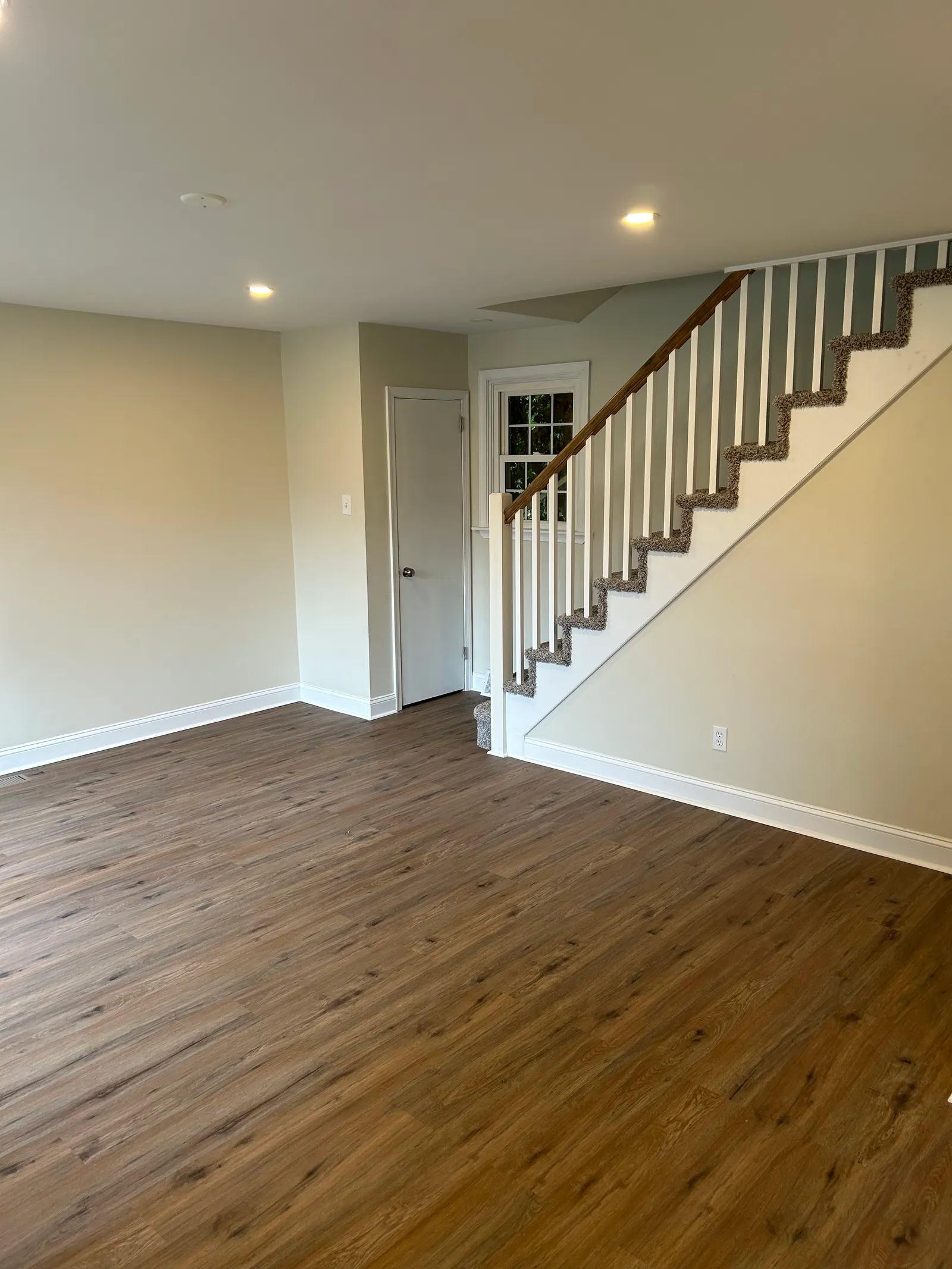
Luxury vinyl plank (LVP) and hardwood can look close to identical from across a room, but they behave very differently once water, dogs and twenty years of living get involved. If you're choosing floors for a split-level in Norristown, a colonial in Blue Bell or a rowhome in Northeast Philadelphia, the right answer usually depends on the room, not the whole house.
Water resistance: basements, bathrooms and kitchens
This is the biggest difference between the two. HomeAdvisor describes vinyl as having a waterproof core that holds up in moisture-prone areas. The same source says hardwood is not advised for bathrooms, laundry rooms and basements, because excess humidity damages the wood, and recommends mats near the kitchen sink.
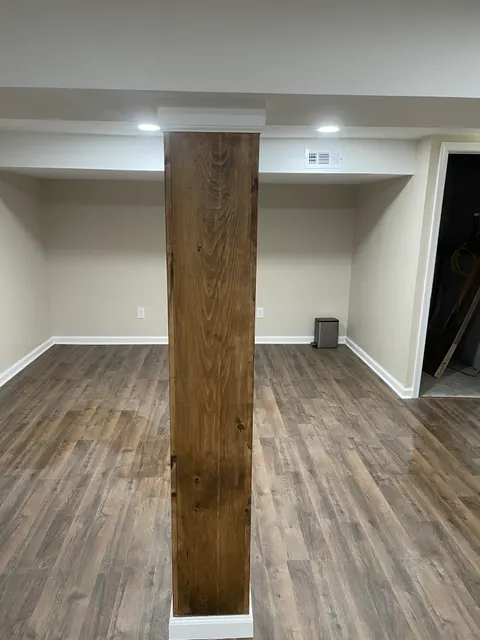
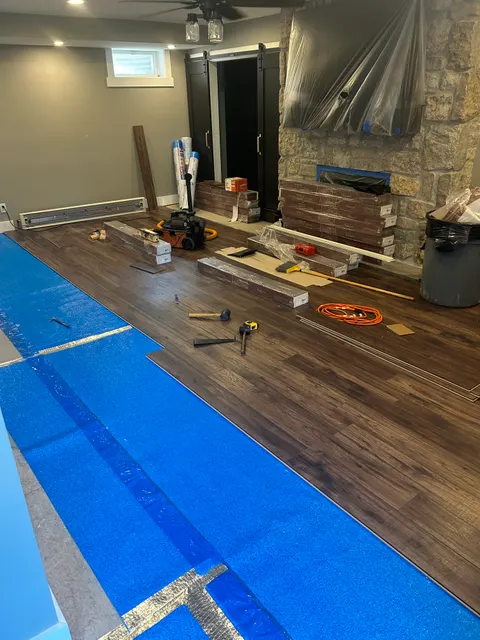
- Basements. Below-grade concrete gives off moisture, and Fixr notes hardwood over concrete needs a vapor retarder and a wood subfloor first. LVP floats over the slab with an underlayment, which is why it is the usual choice for finished basements around here.
- Bathrooms and laundry rooms. LVP handles splashes and wet feet well. A waterproof plank does not make the room waterproof, though. Water that gets past the edges or under a toilet can still reach the subfloor.
- Kitchens. Either floor works. Hardwood gives you a continuous look into the rest of the first floor; LVP shrugs off a leaking dishwasher better.
Durability, pets and kids
LVP is built with a clear wear layer on top of a printed image. Thicker wear layers resist scratches from dog nails, toy trucks and chair legs better; Fixr's sample project uses a 20 mil plank. Scratch-resistant is not scratch-proof, and heavy furniture can dent softer products, so felt pads still matter.
Hardwood scratches and dents more easily, especially softer species. The difference is what happens later. Hardwood can be sanded and refinished, and Fixr says both solid and engineered floors can last 50 years or more with care, with solid wood reaching up to 100. Engineered hardwood has a thinner real-wood veneer, which Fixr says limits it to about five or six refinishes. A worn LVP plank cannot be refinished; it gets replaced.
For a busy household with a big dog, LVP is the lower-stress floor. For a quieter house where you want a floor that ages with the home, hardwood earns its price.
Look, feel and resale value
Good LVP has embossed texture and wide planks that read convincingly as wood. Up close, real hardwood still wins on grain variety and the way it takes on a patina, and many buyers still treat it as a premium feature.
The numbers back that up. The 2022 Remodeling Impact Report from the National Association of Realtors and NARI estimated that refinishing hardwood floors recovered 147 percent of its cost at sale, and new wood flooring 118 percent, the two highest figures for interior projects that year. If you have oak hiding under old carpet, refinishing it is often the smartest money in the house.
LVP vs. hardwood cost per square foot
Published installed-cost ranges, materials and labor together:
| Floor | Fixr (installed) | HomeAdvisor (2026) |
|---|---|---|
| Luxury vinyl plank Floating click-lock or glue-down | $5 to $12 most projects ($3 to $16 full range) | $3 to $10 for LVP material, plus $3 to $10 labor |
| Engineered hardwood Real-wood veneer over plywood layers | $8 to $14 | $5 to $20 |
| Solid hardwood Nailed down over a wood subfloor | $9 to $23 | $10 to $25 |
| Ceramic or porcelain tile Set in thinset, grouted | Not listed | $5 to $45 |
Add-ons can matter as much as the flooring itself. HomeAdvisor lists old flooring removal at $2 to $4 per square foot and subfloor repairs at roughly $400 to $3,000. These are typical industry ranges, not our prices, and every job gets a free written estimate based on your rooms and the product you pick.
Subfloor prep in older homes
Many houses in Montgomery County and Philadelphia were built between the 1920s and 1970s, and their floors show it: board subfloors, humps over beams, and layers of old vinyl or tile stacked on each other. The two floors react differently:
- LVP needs flat. Thin planks telegraph every dip, and a soft spot flexes the click joints until they open. Manufacturers publish flatness tolerances, commonly around 3/16 inch over 10 feet, so high spots get ground and low spots get filled with leveling compound first.
- Hardwood needs solid. Nail-down flooring is more forgiving of small dips but needs a sound wood subfloor to hold fasteners. Loose or squeaky boards get screwed down or replaced.
- Old layers. Family Handyman notes vinyl plank can go over existing tile, wood or concrete if it is undamaged and level. Decades-old resilient flooring can contain asbestos, and the EPA advises against sanding or leveling asbestos flooring or its backing, so suspect layers get tested or covered, not ground down.
Stairs, doorways and transitions
Stairs take the most labor per square foot of any floor. HomeAdvisor puts hardwood stair installation at $75 to $200 per stair, and Fixr at $100 to $200 per step. LVP on stairs needs a matching stair nose on every tread and careful gluing, and many homeowners choose carpet or a runner there instead.
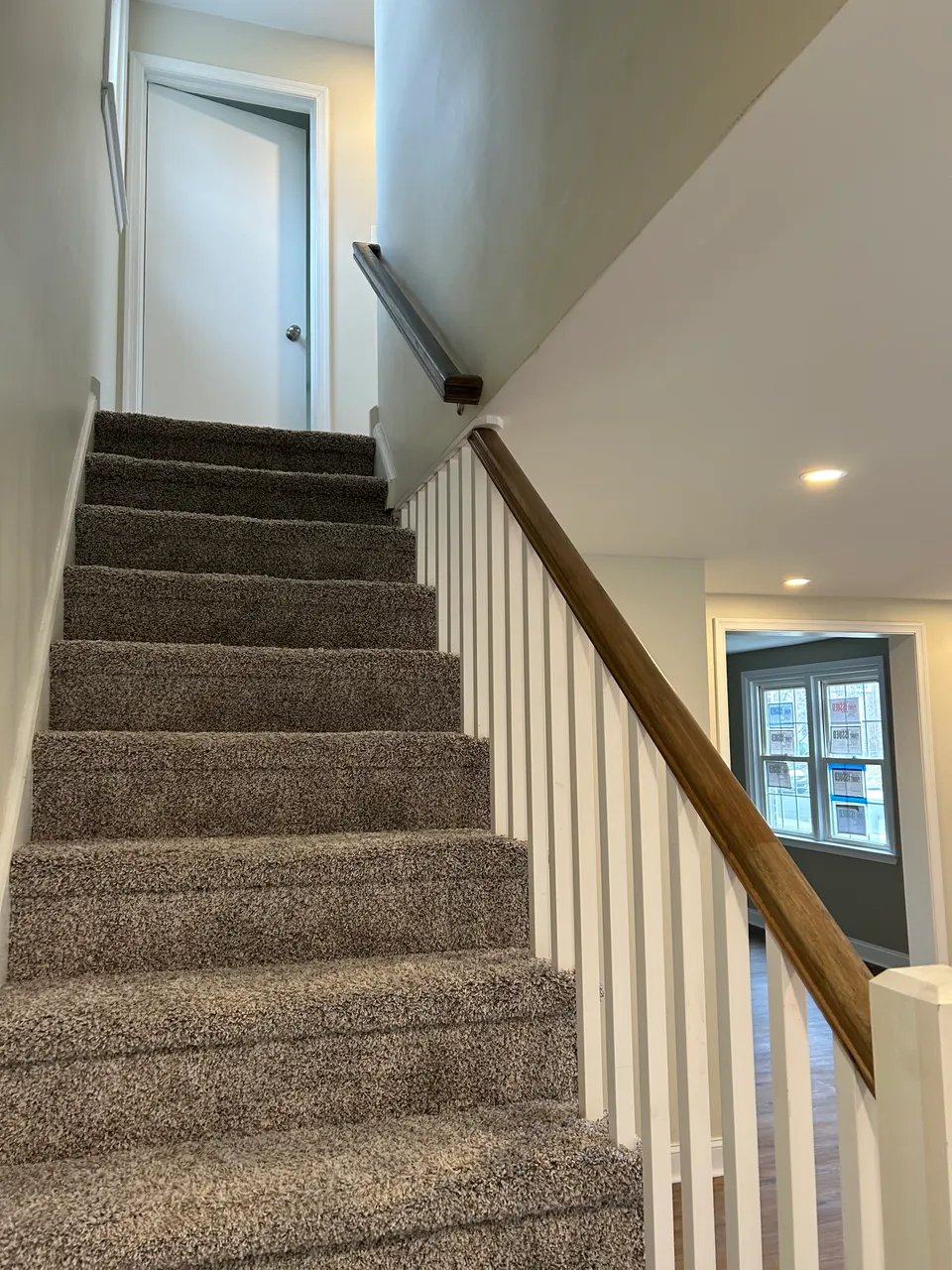
At doorways, floating LVP needs an expansion gap at walls and transition strips; Family Handyman calls for a 1/4-inch gap and T-molding or reducers where floors meet. Door jambs get undercut so planks slide beneath them instead of being caulked around. Solid hardwood is usually thicker than LVP, so check how it will meet existing tile in a kitchen or bath before you order.
When tile beats both
Porcelain or ceramic tile is still the right call in a few places: shower floors and wet bathroom floors that see standing water, mudrooms and entries where salt and slush get tracked in, and laundry rooms on the main floor. It costs more to install than most LVP and it is cold and hard underfoot, but water sitting on it is not a problem. See our bathroom remodeling page for how we handle tile in wet areas.
Not sure which floor fits which room? We'll walk the house with you, check the subfloor, and give you a free written, itemized estimate for each option so you can compare. Request your estimate.
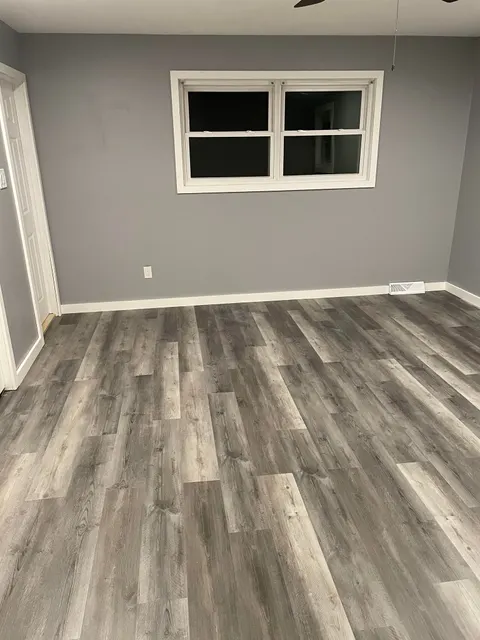
Floors we've installed nearby
These are our own job sites. See more flooring photos in the gallery.
LVP vs. hardwood questions
Is LVP cheaper than hardwood?
Usually. Fixr puts most installed LVP projects at $5 to $12 per square foot, compared with $8 to $14 for engineered hardwood and $9 to $23 for solid hardwood. Subfloor prep, removal and stairs can change the math. Every job gets a free written estimate.
Can you put hardwood in a basement?
Solid hardwood is a poor fit below grade. HomeAdvisor advises against hardwood in basements because humidity damages the wood, and Fixr notes hardwood over concrete needs a vapor retarder and subfloor. LVP is the common choice for finished basements.
Is LVP good for dogs?
It is one of the better options. A thicker wear layer resists nail scratches and the planks do not absorb accidents. It is scratch-resistant, not scratch-proof, and a damaged plank is replaced rather than refinished.
Does hardwood add more resale value than LVP?
Buyers generally treat hardwood as a premium feature. The 2022 NAR and NARI Remodeling Impact Report estimated new wood flooring recovered 118 percent of its cost and refinishing existing hardwood 147 percent.
Can LVP go over my existing floor?
Often, if the existing floor is sound, flat and well attached. Carpet always comes up, and old sheet vinyl or tile should be checked for asbestos before it is disturbed.
Sources
- Fixr: Luxury vinyl plank flooring cost and Fixr: Hardwood floor installation cost, updated January 2025
- HomeAdvisor: Vinyl flooring cost, hardwood floor cost and tile installation cost, updated June 2026
- Family Handyman: How to install vinyl plank flooring
- National Wood Flooring Association, summarizing the 2022 NAR/NARI Remodeling Impact Report
- EPA: Protect your family from exposures to asbestos