- Cost ranges
- By component
- Tiled vs. prefab base
- Drains & curbless
- Glass
- Niches & benches
- What moves the price
- FAQ
"Walk-in shower" covers everything from a 32-inch acrylic stall to a tiled room with a bench, two shower heads and a wall of glass. That's why published prices look so far apart. This guide lines up the 2026 numbers for the Philadelphia area and then takes the shower apart piece by piece: the base, the drain, the glass, the niche and the bench.
Walk-in shower cost ranges for 2026
- Angi's Philadelphia walk-in shower page (updated July 2026) puts the average Philadelphia walk-in shower at about $9,234, with most installations between $6,156 and $12,312. It lists prefabricated units at $718 to $3,078 and custom showers at $4,309 to $8,721, and labor at $410 to $2,052, all before extras like tile work and plumbing. Adding plumbing for a shower runs $616 to $1,642.
- HomeAdvisor (updated June 2026) puts professional shower installation at $4,448 to $12,373, with most homeowners spending around $8,204. Prefab showers start around $1,000, and a tiled walk-in shower can reach $17,500.
- Fixr (updated March 2025) puts the national average at $8,000, with most projects between $5,000 and $11,000. Prefab walk-in showers run $2,000 to $8,000 and custom ones $5,000 to $20,000.
Angi's component ranges don't add up to its average on purpose: the average is for whole jobs, and the component figures leave out tile, plumbing and other extras. The useful takeaway is the pattern across all three sources. A finished, professionally installed tiled walk-in shower in this area commonly lands somewhere between the mid four figures and the low five figures, depending on size and finishes. These are regional and national estimates, not our prices. Every job gets a free written estimate based on your bathroom.
If you're replacing a tub, the conversion adds demo and drain work; our tub-to-shower conversion guide covers that side. For whole-room budgets, see the bathroom remodel cost guide.
Walk-in shower cost by component
Published installed ranges for the pieces that make up a walk-in shower:
| Component | Published range | Source |
|---|---|---|
| Prefab shower, installed Acrylic, fiberglass or composite base and walls | $2,000 to $8,000 | Fixr (2025) |
| Custom tiled shower, installed Ceramic tile $6,000 to $12,000; porcelain $7,000 to $14,000 | $5,000 to $20,000 | Fixr (2025) |
| Shower pan Premade pan installed vs. custom tile pan | $900 to $2,000 (HomeAdvisor); premade $500 to $1,550, custom tile $900 to $3,500 (HomeGuide) | HomeAdvisor (2026), HomeGuide (2023) |
| Glass Framed door, frameless door, full enclosure | $300 to $1,200 framed; $900 to $2,300 frameless; $1,800 to $5,000 enclosure | Fixr (2025) |
| Niche Each, recessed between studs | $100 to $400 | Fixr (2025) |
| Bench Built-in, tiled | $100 to $500 (Fixr); $300 to $800 (HomeGuide) | Fixr (2025), HomeGuide (2023) |
| Linear drain Part cost compared with a standard center drain | Most $200 or more vs. about $20, plus a few hundred dollars more labor | Angi (2026) |
| New drain location Labor and materials to add or move the drain | $750 to $1,300 | HomeAdvisor (2026) |
| Permits When plumbing or framing changes | $100 to $500 | Fixr (2025) |
For Philadelphia specifically, Angi lists tiling contractors at $31 to $123 an hour or $3 to $15 a square foot, and a shower door at $825 to $2,060 installed. HomeAdvisor's national glass figure is $530 to $3,300 installed.
Tiled pan vs. prefab base
The floor of the shower is the most important decision after size, because it sets the drain location, the slope and how the waterproofing ties together. There are three common ways to build it:
- Prefab base. An acrylic, fiberglass, composite or solid-surface pan with the slope molded in. It's the quickest and least expensive floor, and it pairs well with tile walls. The limits are the manufacturer's sizes and drain positions. If your space is 50 inches and the bases come in 48 and 60, the walls get built out to fit the base.
- Pre-sloped foam tray. A tile-ready foam base, part of a bonded waterproofing system, with the slope built in and a drain made to tie into the membrane. HomeGuide puts tile-ready pans at $500 to $800 for the pan alone. They save a day or more of floor work compared with a mortar bed.
- Mortar bed. The traditional "mud" floor: sand and cement packed and screeded to slope by hand, then waterproofed and tiled. It fits any size or shape and any drain position, which is why it's used for odd layouts and benches that run into the floor. HomeGuide notes a poured mud base takes several days to cure.
The tile choice follows the floor. A center drain means the floor slopes in from four sides, so small tile like penny rounds, hexagon mosaic or river pebble is used to follow the slope without lippage. Large tile works on a floor that slopes in one direction to a linear drain. How each floor gets waterproofed is in our shower waterproofing guide.
Drain options: center, linear, and curbless
Center drain
The standard square or round drain in the middle of the floor. It's the least expensive drain and the easiest to plumb. The trade-off is the four-way slope, which limits floor tile to smaller pieces.
Linear drain
A long, narrow channel set against a wall or across the entry. Angi notes most linear drains cost $200 or more, compared with about $20 for a basic center drain, and that coordinating the tile setter and plumber can add a few hundred dollars of labor. What you get: a floor that slopes one way, room for large-format tile, and better drainage for big showers or multiple shower heads.
Curbless entry
A curbless shower has no step at the entry; the bathroom floor runs straight into the shower. This Old House puts curbless showers at $8,000 to $15,000. The extra cost is structural. The 2021 IRC that Pennsylvania uses requires the shower floor to slope toward the drain at ¼ to ½ inch per foot, so the shower floor has to start lower than the bathroom floor. That usually means recessing the subfloor between or into the joists (which may need an engineer's input on how the joists are cut or reinforced), or building up the rest of the bathroom floor to match. A linear drain at the entry is often part of the design to catch water before it reaches the room.
A curbed shower is simpler. Code sets the curb at 2 to 9 inches deep, measured from the top of the curb to the top of the drain. A low curb with a wide opening is easy to step over and keeps water where it belongs.
Glass: framed, frameless, or a fixed panel
- Framed doors have a metal frame around the glass. Fixr puts them at $300 to $1,200. They're the least expensive glass and the most forgiving of walls that aren't perfectly plumb.
- Frameless doors use thicker glass with hinges mounted straight to the wall or a fixed panel, at $900 to $2,300 per Fixr. The hinges need solid blocking behind the tile, which gets framed in before the walls close.
- Full enclosures with a door and one or more fixed panels run $1,800 to $5,000 per Fixr.
- A fixed panel with no door works when the shower is long enough that water doesn't reach the open end. It needs more floor space than a door does.
Glass is measured after the tile is finished, so it's usually the last item installed. Under the 2021 IRC, hinged shower doors must open outward. If you're planning a bench or grab bars, decide before tile so the glass layout and blocking match.
Niches and benches
A recessed niche holds bottles without a caddy hanging off the shower head. Fixr prices niches at $100 to $400 each. A few details decide whether one looks right and stays dry:
- Location. Interior walls are best. A niche in an exterior wall takes the place of insulation and puts a cold spot behind your shampoo.
- Layout. The niche height and width should land on full or evenly cut tile courses, and the shelf should be set in line with a grout joint.
- Water. The sill should pitch slightly toward the shower, and the inside corners get the same membrane treatment as the rest of the wall.
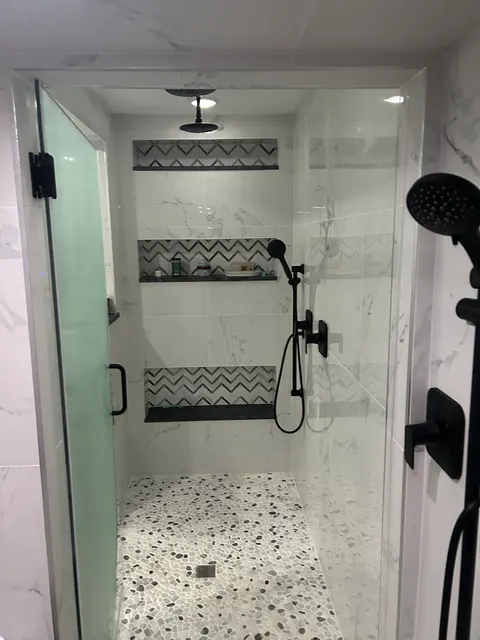
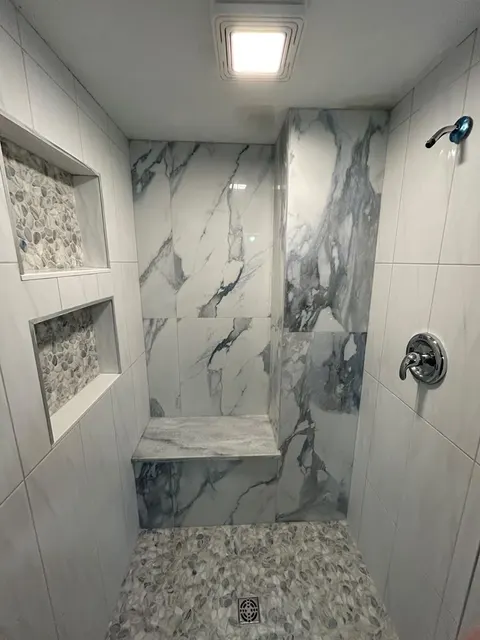
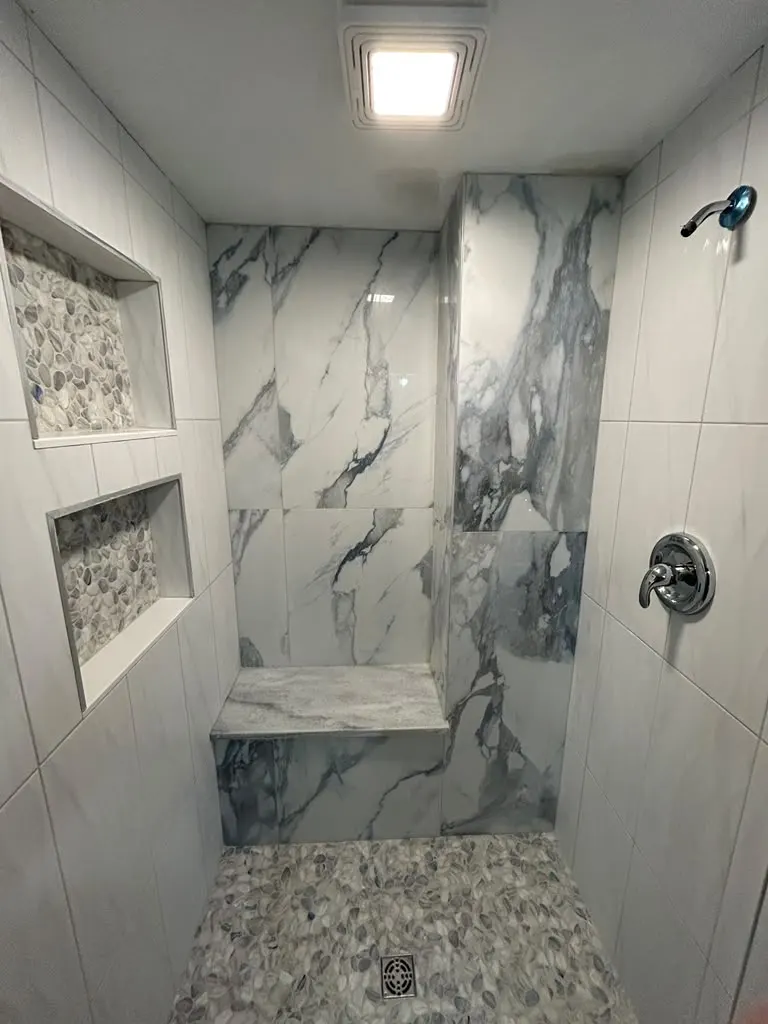
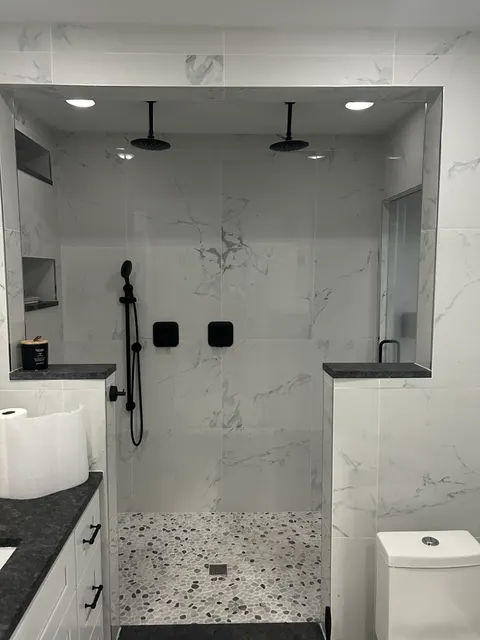
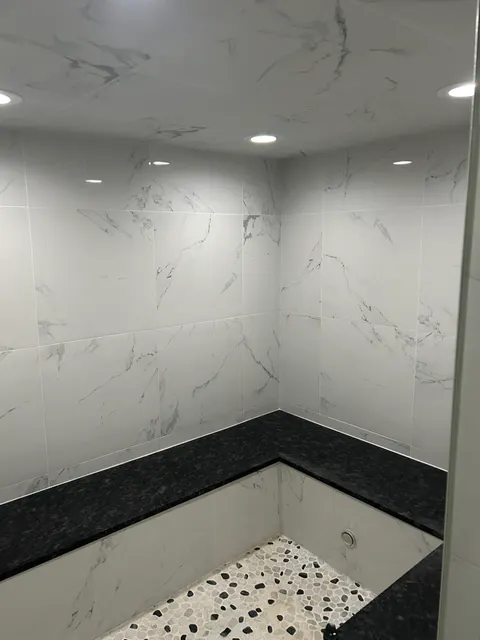
Benches come in three types: a built-in bench framed or built from block and tiled, a corner seat set into the tile, or a fold-down seat mounted to blocking. Fixr puts a bench at $100 to $500 and HomeGuide at $300 to $800 for a custom bench. A built-in bench is waterproofed as part of the shower and its top should slope back toward the drain. The pebble-floor walk-in shower we built has a stone-topped bench and two stacked niches, and the marble-look shower with dual rain heads has an L-shaped bench along two walls with three niches.
What moves the price of a walk-in shower
- Size. Angi's Philadelphia figures run from $821 to $3,078 for a 32-by-32-inch shower to $2,052 to $10,260 for a 60-by-42-inch one. More floor means more tile, membrane and glass.
- Prefab or tile. The single biggest swing. Fixr's prefab range tops out at $8,000, while custom tiled showers run to $20,000.
- Tile and pattern. Large-format porcelain, mosaics, herringbone and tile on the ceiling all add labor. Large tile also needs flat walls and full mortar coverage on the back.
- Moving the drain. HomeAdvisor puts a new drain location at $750 to $1,300. A second-floor bath over a finished ceiling adds patching below.
- Valves and heads. A rain head plus a hand shower or body sprays means more valve work. The 2021 IRC sizes the shower trap by total flow, so a high-flow setup above 5.7 gallons per minute calls for a 2-inch trap instead of 1½ inch.
- Glass. Framed vs. frameless vs. a full enclosure.
- Curbless entry. Recessing the floor is framing work on top of the shower itself.
- What's behind the old shower. Many homes here were built between the 1920s and 1970s. Soft subfloor, old drain lines and tile set in mortar on wood lath show up once the walls are open.
For accessibility, HomeAdvisor notes an ADA-compliant shower must be at least 36 inches square. The 2025 Cost vs. Value Report priced a universal design bath with a curbless walk-in shower at $45,749 for the Philadelphia market, though that figure covers the whole room.
Every project starts with a free walkthrough and a written, itemized estimate that prices the base, waterproofing, tile, glass and any plumbing changes as separate lines, so you can see what a bench or a linear drain adds before you decide. New rough-in is done with licensed trade partners we coordinate. Request your estimate.
How long a walk-in shower takes
Most of our bathroom remodels take two to four weeks from demo to final walkthrough, and a full gut with a custom tiled shower sits at the longer end, since the membrane cures, grout sets, and glass is measured after tile. A prefab shower in an existing footprint is much faster. For a phase-by-phase breakdown, see how long a kitchen or bathroom remodel takes.
Walk-in showers we've built nearby
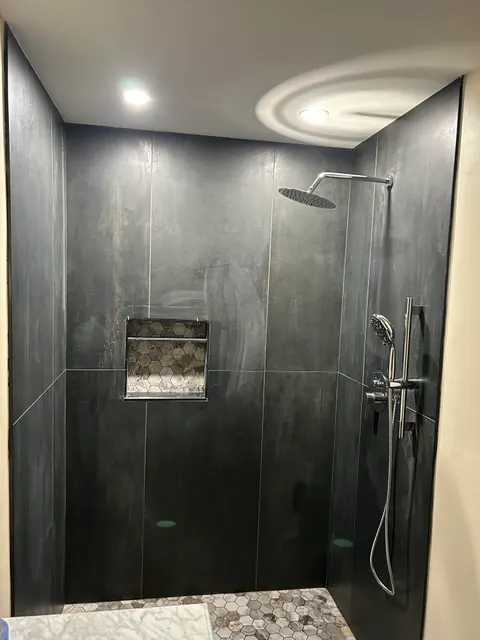
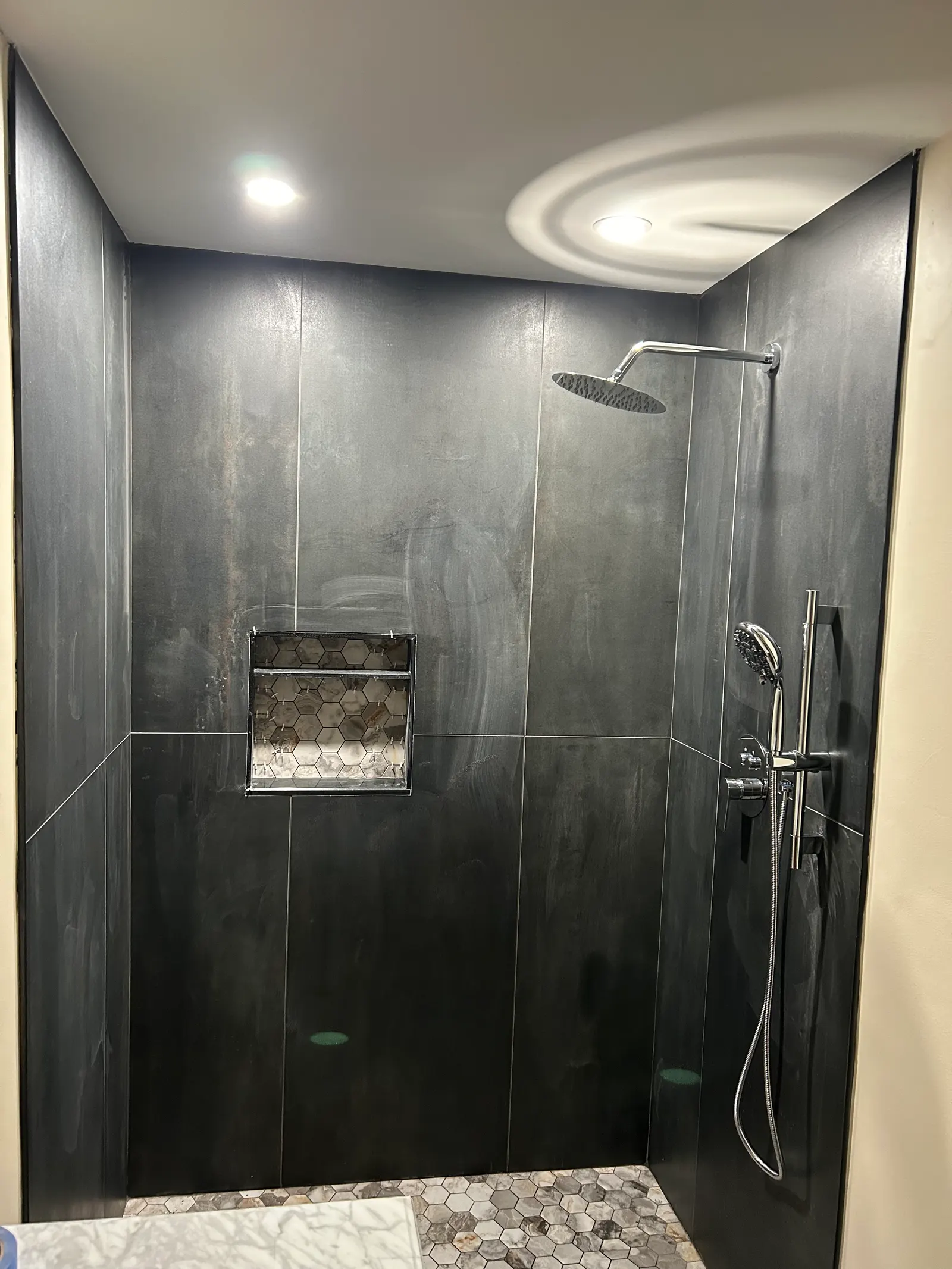
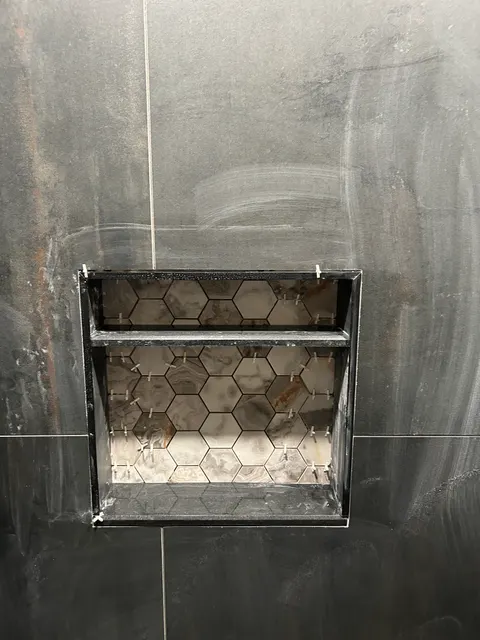
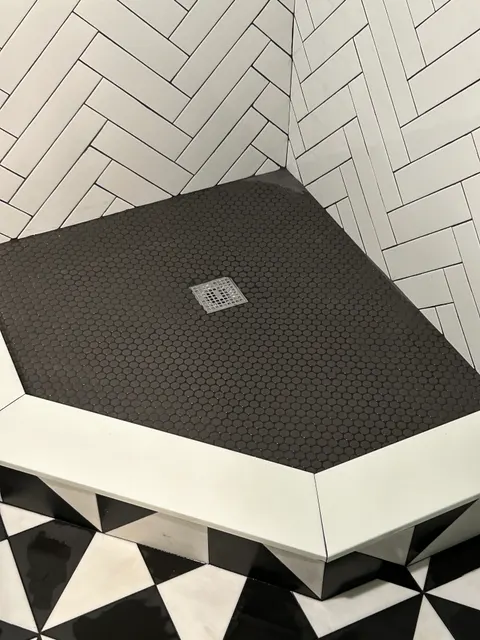
These are our own job sites. See more bathroom photos in the gallery, or read the charcoal porcelain walk-in shower write-up for a build from membrane to finished tile.
Walk-in shower cost questions
How much does a walk-in shower cost in the Philadelphia area?
Angi's Philadelphia data (July 2026) puts the average walk-in shower at about $9,234, with most between $6,156 and $12,312. HomeAdvisor's national range is $4,448 to $12,373. Every job gets a free written estimate based on your bathroom.
Is a tiled shower more expensive than a prefab one?
Yes, usually by a wide margin. Fixr puts prefab walk-in showers at $2,000 to $8,000 installed and custom tiled showers at $5,000 to $20,000. A prefab base with tile walls is a common middle option.
Is a linear drain worth the extra cost?
It makes sense for large-format floor tile, curbless entries and big or multi-head showers, because the floor slopes one way. Angi notes most linear drains cost $200 or more compared with about $20 for a center drain, plus a few hundred dollars more labor.
How much more does a curbless shower cost?
This Old House puts curbless showers at $8,000 to $15,000. The shower floor has to sit lower than the bathroom floor to slope to the drain, which usually means recessing the subfloor or raising the rest of the room.
How much do a shower niche and bench add?
Fixr prices a niche at $100 to $400 each and a bench at $100 to $500. HomeGuide puts a custom shower bench at $300 to $800. Both are waterproofed as part of the shower and are easiest to add before the walls are closed.
Sources
- Angi: Walk-in shower cost in Philadelphia, PA, updated July 2026; Angi: Shower remodel cost in Philadelphia, PA, updated June 2026; Angi: Linear shower drain pros and cons, updated July 2026
- HomeAdvisor: Shower installation cost, updated June 2026
- Fixr: Walk-in shower cost, updated March 2025
- HomeGuide: Walk-in shower cost and shower pan cost, 2023
- This Old House: Tub-to-shower conversion cost, March 2026 (curbless shower range)
- Cost vs. Value Report 2025, Philadelphia, PA market data (Zonda / Remodeling)
- 2021 IRC Chapter 27 (P2708, P2709) and Table P3201.7